Rhodes · Greece · UNESCO World Heritage

Rhodes Old Town

Rhodes Old Town is the walled medieval town at the centre of Rhodes Town, at the northern tip of the Greek island of Rhodes. The Knights of St John built it up from 1309, and UNESCO listed it in 1988. People still live inside its 4 km of walls, and visitors walk in through the gates.

What to seeFind a hotel

Updated

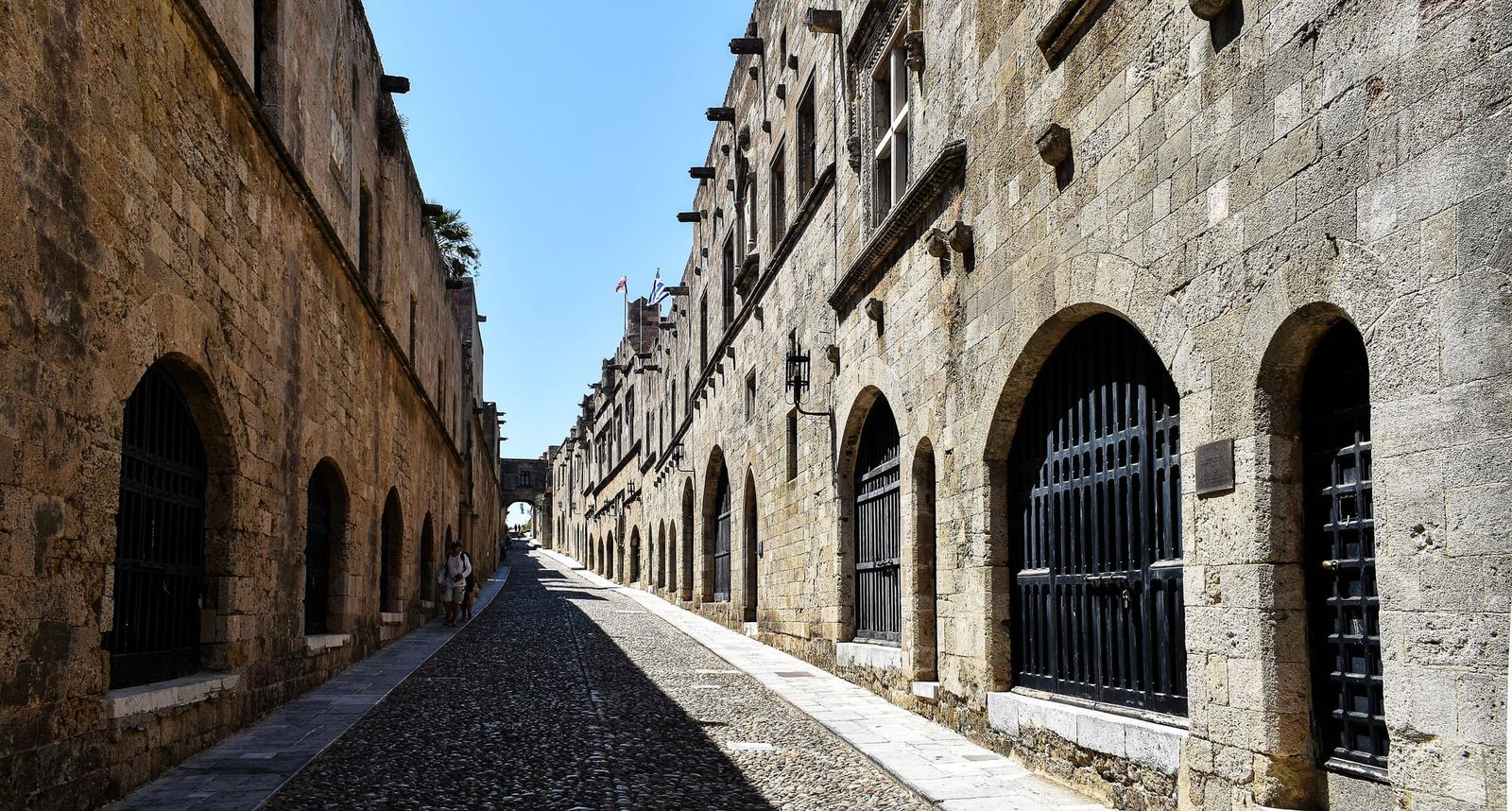
The Street of the Knights in Rhodes Old Town: a cobbled street between the stone facades of the inns, under a blue sky

Key facts

UNESCO World Heritage
Since 1988Listed as the Medieval City of Rhodes
Walls
4 kmRight round the medieval town
Inside the walls
About 41 hectaresStraight streets in the north, lanes and small squares in the south
Residents
About 2,000At the 2011 census
The Knights of St John
1309–1522The palace, the inns and the walls are theirs
Cars
Permit onlyVisitors park outside the walls
Across the town on foot
10 min on footHippocrates Square to the d’Amboise Gate

What Rhodes Old Town is

Rhodes Old Town is the medieval town inside Rhodes Town, the island’s capital at its northern tip. A wall 4 km long surrounds it, and about 41 hectares lie inside. It is a working part of the town, with shops, restaurants and homes: about 2,000 people lived inside the walls at the 2011 census.

UNESCO put it on the World Heritage List in 1988 as the Medieval City of Rhodes, for three reasons. Its fortifications were a model for the eastern Mediterranean at the end of the Middle Ages. The Knights’ quarter is a Gothic town that still has its palace, its hospital and its street of inns. And in the lower town Gothic houses stand beside the mosques and baths of the Ottoman centuries, the work of one culture laid over another.

The place is older than its walls. The ancient city of Rhodes was founded here in 408 BC, and the Knights of St John ruled from 1309 to 1522. The history of the old town runs from that first city through the Knights and the Ottomans to the Italians.

The two quarters inside the walls

The town inside the walls has two parts. The high town in the north, the Collachium (Kollakio in Greek), was built by the Knights and was once walled off from the rest. Its streets are straight, and the palace, the inns and the hospital stand along them.

The lower town to the south, the Burgo, is larger and irregular: streets and lanes lead to small squares. This was where the townspeople lived and traded, and where the Ottomans later built mosques and a bath. The Jewish community lived in its eastern part, in narrow winding lanes known as the Juderia. The Jewish Quarter in the east of the town still has its synagogue.

Under Ottoman rule Christians were not allowed to live inside the walls, and the gates were shut at night. Greeks who kept shops inside went home each evening to new neighbourhoods beyond the walls, the beginning of the town that grew outside the walls.

What to see in Rhodes Old Town

Walking times start at Hippocrates Square, the square just inside the Marine Gate.

Four inns

Street of the Knights

The pebble-paved main street of the Knights’ quarter, lined by the inns of Italy, France, Spain and Provence.

Paid entry

Archaeological Museum

The Knights’ hospital of the 15th century, on the south side of the street, now the museum.

The moat is free

Walls and gates

The gates and where each one leads, and the moat, a free walk at any hour.

In the east of the town

Jewish Quarter

Kahal Shalom Synagogue, the Jewish Museum and the Square of the Jewish Martyrs.

10 min on foot from end to end

Map of the old town

Every gate and sight on one map, with a route from gate to gate.

Square

Hippocrates Square and the Castellania

1 min on foot 60 m

The square inside the Marine Gate, with a marble fountain. Sokratous Street and Aristotelous Street start here. The Castellania on its edge was built in 1507 as a court of the Knights and now houses the municipal library.

Seen from outside

Suleiman Mosque

6 min on foot 400 m

At the top of Sokratous Street, on the hill of the old town. It was founded in the 16th century under Suleiman the Magnificent and rebuilt in 1808; its minaret is 34.5 m high. The mosque is closed to worship and to visitors, so it is seen from the street.

Café and viewing terrace

Clock tower

6 min on foot 420 m

Ahmed Fethi Pasha built it between 1850 and 1852, near his father’s library, the Hafiz Ahmed Aga Library. It now works as a café with a viewing terrace.

Open
Every day 09:00 to 21:00

Ottoman library

Hafiz Ahmed Aga Library

6 min on foot 440 m

Built as a library in 1793, opposite the Suleiman Mosque. It holds 1,265 manuscripts and has been a museum open to the public since 1963.

Open
Monday to Saturday 09:30 to 15:00

Paid entry

Our Lady of the Castle

3 min on foot 200 m

Panagia tou Kastrou: a Byzantine church that the Knights rebuilt as a Gothic basilica and the Ottomans used as a mosque. It shows icons and medieval sculpture, as one of the museums of the old town.

A ruin, open to walk through

Panagia tou Bourgou

4 min on foot 270 m

The ruin of an early 14th-century Gothic church in the lower town. It is open to the public, and concerts are sometimes held in it.

Parish church

Agios Fanourios

A 13th-century church with frescoes, on the street of the same name. It is still a parish church.

The Turkish bath of 1558 has been closed since 2011 and is waiting to be restored.

Outside the walls

Mandraki Harbour

The deer on their columns, three windmills and the Fort of St Nicholas.

Outside the walls

Colossus of Rhodes

Nothing of the statue remains. Where it stood, and what stands there now.

Outside the walls

Acropolis of Rhodes

The highest part of the ancient city, west of the old town: temples and public buildings on terraces.

Outside the walls

Rhodes Town

The new town beyond the gates, with the New Market and the aquarium.

18 min on foot

Beaches

Elli Beach at the northern tip of the island, with sunbeds, umbrellas and beach bars.

Background

History

The ancient city, the Knights and their sieges, the Ottomans and the Italians.

From the old town

Day trips

Lindos, Symi and Kallithea Springs by bus or boat from the town.

Getting in by the gates

The old town is entered on foot. Each of its main streets ends at a gate, so the gate you take decides where your walk begins.

  • From the bus: the Liberty Gate

    The town buses and the island buses start and end outside the New Market (Nea Agora), Mandraki, north of the walls. The Liberty Gate, between Mandraki and the Kolona harbour, is the way in from there. The buses from the airport and the resorts all arrive at this stop.

    • 10 min on foot
  • From a cruise ship: St Catherine’s Gate

    Cruise ships berth at the Tourist Port, east of the walls, and St Catherine’s Gate is the nearest way in. Ferries and day boats use other quays: the walk from each quay to the gates differs.

    • 9 min on foot
  • From the Symi catamaran: the Marine Gate

    The catamarans to Symi use the Kolona quay. The Marine Gate opens from the harbour onto Hippocrates Square.

    • 4 min on foot
  • By taxi: the Marine Gate or the Liberty Gate

    Taxi ranks stand outside the Marine Gate and the Liberty Gate. A taxi sets you down outside the walls, and the rest is on foot.

  • By car: park outside the walls

    Cars enter the walls only with a permit from the municipality, so visitors leave the car outside. The large municipal car park at Akantia, by the commercial port, is free. Where to leave the car depends on the gate you want to walk in by.

Every gate and where it leads

When to go

July and August are the warmest months: the average daily high at the weather station at Rhodes airport is about 31 °C, against about 15 °C in January. The palace and the museums keep their longer summer hours from 1 April to 31 October.

Almost no rain falls from June to September. The weather month by month gives the temperatures and the rain for every month of the year.

Eating, shopping and hotels

Where to eat inside the walls

Two local things to order: pitaroudia, a fried appetiser of chickpeas, onion and tomato, and melekouni, a sweet of sesame, almonds and honey.

Shopping on Sokratous Street

The shopping street of the old town, 3 min on foot from Hippocrates Square: souvenirs, clothes, jewellery, leather, ceramics and carpets.

The old town after dark

In the evening the lanes fill with wine bars, tavernas and open-air cafés. The well-known bars are around Hippocrates Square and on Menekleous Street; local people tend to meet at the small bars on Arionos Square. The new town has a bar street of its own.

Rhodes Old Town, Medieval City, Palia Poli

In English the place is Rhodes Old Town, or the Old Town of Rhodes. Its name on UNESCO’s World Heritage List is the Medieval City of Rhodes. In Greek it is the Palia Poli (Παλιά Πόλη), the old town, or the Mesaioniki Poli tis Rodou (Μεσαιωνική Πόλη της Ρόδου), the medieval town of Rhodes. Rhodes Town is the whole town, the old town included.

Frequently asked questions

Where is Rhodes Old Town?

In the centre of Rhodes Town, the capital of the island of Rhodes, at the island’s northern tip. It lies beside the harbours. The bus stops at the New Market are 10 min on foot from Hippocrates Square, the square inside the Marine Gate.

What is there to see in Rhodes Old Town?

The Palace of the Grand Master, the Street of the Knights with its inns, the Archaeological Museum in the Knights’ hospital, the walls and the moat, and the Jewish Quarter with Kahal Shalom Synagogue. The town is small: the d’Amboise Gate, one of the two gates farthest from Hippocrates Square, is 10 min on foot away.

Is Rhodes Old Town worth visiting?

It has been a UNESCO World Heritage Site since 1988. UNESCO lists it for three things: fortifications that were a model for the eastern Mediterranean, the Gothic quarter the Knights built, and the Ottoman mosques and baths that stand among the medieval houses. It is also a town where people live, with shops, restaurants and homes.

Do people still live in Rhodes Old Town?

Yes. About 2,000 people lived inside the walls at the 2011 census, and the old town is a living part of the modern town, with shops, restaurants and homes.

Is the Medieval City of Rhodes the same as Rhodes Old Town?

Yes. Medieval City of Rhodes is the name on UNESCO’s World Heritage List; Rhodes Old Town is the everyday name. Greek uses both as well: Palia Poli, the old town, and Mesaioniki Poli, the medieval town.

Which sights in the old town charge entry?

The Palace of the Grand Master, the Archaeological Museum and the church of Our Lady of the Castle charge entry. The moat is free at any hour.